

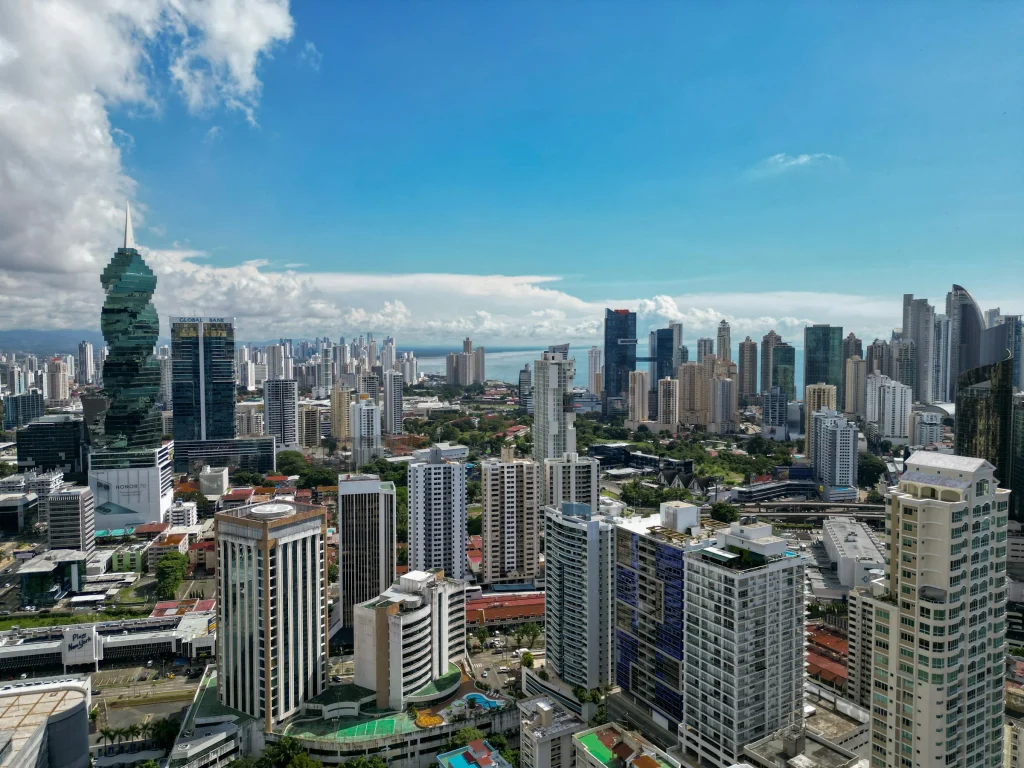
With the average gross residential rental yield around 6.95%, buying property in Panama has become a strategic asset for many American investors. Although foreigners face some restrictions when purchasing real estate in Panama, the process is straightforward if they know the basic steps. The first step is to find the right property and confirm that the title is clean and free of liens. After successful due diligence, investors can seal the deal by meeting the legal requirements.
In addition to its straightforward process, buying a home in Panama appeals to many American investors thanks to its geographic proximity to the US, the use of the US dollar as currency, a territorial tax system, a path to permanent residency, and a stable economy.
In this guide, we will consider the pros and cons of Panama real estate, then explain how the purchasing process works for a foreign investor.
Can Foreigners Buy Property in Panama?
Regardless of their nationality, foreigners can buy private property in Panama without any residency requirement, with nearly the same rights as Panamanian citizens. They can buy residential and commercial properties and even undeveloped land.
However, as with buying property in Turkey, some restrictions apply to overseas Panama real estate investors. These are:
- Foreigners are prohibited from owning titled property within 10 kilometers of Panama’s land borders with Costa Rica or Colombia
- You cannot privately own the first 22 meters of beachfront from the high-tide line on Panama’s Pacific coast or the first 10 meters on its Atlantic coast, as these areas are considered public domain.
- Foreigners cannot buy properties in military zones or indigenous reservations.
Therefore, it is important to consider these restrictions while buying a property in Panama as a foreigner.
Contact Form
Why Buy Property in Panama?
- Located at the heart of Latin America, Panama combines a growing service-based economy with a relatively stable inflation environment and an internationally connected real-estate market. Accordingly, the World Bank expects GDP growth to reach 3.8-3.9% in 2026.
- Tourism is one of Panama’s strongest sectors. The country received about 1.29 million visitors in the first four months of 2026, up 16.4% year over year. So, it might offer higher short-term rental yield potential. (Airbnb is applicable but subject to laws. So, if your aim is to rent out the property for short-term, you must check out the legal and building rules.)
- The property market has matured over the past two decades. Property prices are around $2,300-4,000 per m², and average gross residential rental yields are around 7.6% in Panama City, while 6.9% nationwide.
- Panama uses a US-dollar-based economy. As a result, you can transact in USD without currency conversion costs.
- Panama Canal still remains one of the country’s biggest revenue generators. It positions Panama as a global logistics and trade hub.
- The country also encourages real estate investments through its Panama Golden Visa program. Starting from a $300,000 real estate investment amount, investors can now obtain permanent residency by purchasing new Panamanian real estate from developers.
- Thanks to Panama’s territorial tax system, investors are taxed only on income generated in Panama. Along with this, the property taxes are among the lowest in the region.
Residency Options You Can Get by Purchasing a Property in Panama
Although there is no residency requirement to buy property in Panama as a foreigner, investors can buy a property that qualifies them for a residency application.
1. Panama Qualified Investor Visa
Also known as the Panama Golden Visa program, the Qualified Investor Visa provides permanent residency in Panama in exchange for a qualifying investment. In terms of real estate investment, there are two available options:
- A resale property: $500,000.
- A new building: $300,000.
After purchasing a property under Panama Golden Visa program, you can rent it out or sell it if you do not want to keep your residency status. The key benefit of this program is that you can apply for Panama citizenship after 5 years of holding your investment property.
2. Friendly Nations Visa
This residency program is for citizens of countries listed as Friendly Nations. These basically include the US, Canada, the UK, EU countries, Australia, New Zealand, Taiwan, Hong Kong, South Korea, Japan, and Singapore.
Under this category, available applicants must invest a minimum of $200,000 in real estate.
3. Pensionado Visa
Mostly preferred by passive income holders and retirees, the Pensionado Visa offers residency in exchange for a property purchase worth a minimum of $100,000 and a minimum monthly income of $750. Thanks to this affordable residency option, Panama is one of the most attractive retirement destinations.
Contact Form
The Real Estate Buying Process in Panama in 2026
Step 1: Deciding on what you really want
Knowing your essentials before talking with a real estate agent in Panama is essential for time efficiency. Start by deciding what type of property you want. Are you looking for a rental property, vacation home, or a property that can grant you permanent residency? This will help you to determine the location of the property too.
Once you decide, set your budget and include potential additional costs.
Step 2: Find a real estate agent
After determining what you want, the next step is finding a real estate agent in Panama. As there is no Multiple Listing Service, you must be careful at this stage to avoid risks of buying property in Panama.
To start with, check out if they have a license and membership in ACOBIR, the Panamanian Association of Real Estate Brokers. You can also search to see if they have any similar experience with expats and investors. At this stage, you can consider taking a look at online discussion forums too.
After doing your research, if you think you have a trustworthy agent, check out the homes for sale in Panama they list for you.
Step 3: Due diligence
Once you have made up your mind, you must check whether the property has any outstanding issues, such as existing debts, liens, unpaid property taxes, or legal disputes, before proceeding with the purchase. Also, make sure that the seller is the registered owner of the property. Your power of attorney at the Public Registry mainly handles this step.
At this stage, you must also check whether the property is titled land or Rights of Possession (ROP). If it is ROP, you must know that it does not carry a full legal title. ROP refers to a property owned by the state, but an individual holds its possession rights. This typically happens rural areas. So, always check the property’s legal status before buying to avoid costly mistakes.
An independent Panamanian real estate attorney can handle this buying process for you by searching the Public Registry.
If the property is clean, you can make your offer and negotiate. If you agree on the price, submit a deposit of around 10% of the asking price.
Step 4: Purchase Panamanian real estate
If your offer is accepted, you can make the payment in two ways: paying cash or using financing.
If you are paying cash, the process is relatively simple. Your money is transferred through an escrow account in their country or a local bank account in Panama; you and the seller sign the final purchase agreement, also known as Escritura Pública. Then your Panamanian attorney submits the documents to the Public Registry to register the property in your name.
If you need a mortgage, foreign buyers can obtain financing from some Panamanian banks within 60-90 days. However, banks generally finance only around 60-70% of the purchase price. This requires you to provide 30-40% as a down payment. Interest rates can be around 5-7%, and mortgage terms are commonly 15-20 years.
While buying a property in Panama as an American, you may also consider using your retirement funds (IRA), borrowing against a US property, or seller or developer financing.
Step 5: Get your title deed
Once everything is ready, you and the seller sign the final documents. Your attorney then files the transfer with Panama’s Public Registry. The registration process generally takes about two weeks, although timing can vary. Once the transfer is registered, the property is officially recorded in your name.
After receiving your registered title deed, have a copy of it filed with the tax records department. Without completing this step, the property rights cannot be yours.
How to Get a Mortgage as a Foreigner in Panama?
If you are seeking ways to finance your property in Panama, you can consider getting a loan in Panama too. Typically, Panamanian banks finance around 60-70% of the purchase price within 60-90 days. They may require you to provide around a 30-40% down payment.
You can expect interest rates of around 5-7% and loan terms of around 15-20 years.
The process requires detailed documentation as foreign buyers face stricter requirements. You need to submit:
- Mortgage application form
- Valid ID card and copy of your passport
- Your tax returns from the last 2 years and, if applicable CPA financial statements.
- Bank records
- Your credit history
- Insurance
- Recent utility bill, showing your name and address
- Two original copies of bank reference letters
- A letter explaining where the income comes from and why the property is being purchased.
- Proof of immigration status if staying longer than the tourist visa allows.
- A property appraisal by a bank-approved appraiser.
- The purchase contract receipt and proof of the down payment.
After you submit your application, the lender will examine your application and decide on the property appraisal. Once your mortgage application is approved, you can sign the mortgage agreement and arrange the transfer of the funds.
Cost of Buying a House in Panama
One-time costs at purchase
There are two sides: the seller and the buyer. The seller pays 2% of the purchase price or registered value as a real estate transfer tax reported on DGI Form 106, and the agent’s fee, if applicable, is typically around 5%. The seller typically pays the real estate transfer tax, but it can be negotiable. There is also a capital gains tax, which is %3 of the property price.
The buyer pays the legal fees, notary, and public registry fees, typically around 1-2% of the purchase price.
As a foreign buyer, you must register with the RUC (Registro Único de Contribuyentes) and obtain a NIT number, also known as a Panamanian tax number.
Ongoing ownership costs to consider
After purchasing the property as a foreign buyer, property owners must consider the ongoing costs of owning a house in Panama. The typical costs include property management fees, utility costs, home insurance, and homeowners association fees.
You will pay low annual property taxes. You can benefit from property tax exemptions too if your property stays below the limit. These rates are highlighted below.
Primary residences:
| Primary Residence / Family Patrimony | Annual Tax Rate |
|---|---|
| $0 – $120,000 | Exempt (0%) |
| $120,001 – $700,000 | 0.5% |
| Over $700,000 | 0.7% |
| Secondary or Investment Properties | Annual Tax Rate |
|---|---|
| $0 – $30,000 | Exempt (0%) |
| $30,001 – $250,000 | 0.6% |
| $250,001 – $500,000 | 0.8% |
| Over $500,000 | 1.0% |
Renting out Your Panama Real Estate: Long-Term & Short-Term
As a foreigner, you can rent out your investment property in the long and short term. However, there are some legal requirements you should consider in short-term rentals:
- The property must be authorized as permiso de alojamiento público turístico in Panama City for any property that will be rented out for less than 45 days by the Autoridad de Turismo de Panamá. Failing to provide authorization for short term rentals might result in severe fines.
- Outside Panama City, short-term rentals are allowed, but there might be local regulations and restrictions.
Also, you must pay a rental income tax, this is a separate payment from annual property taxes.
- Up to $11,000: 0% (tax-exempt)
- $11,001 to $50,000: 15%
- Over $50,000: 25%
Best Places to Buy Real Estate in Panama for Foreign Ownership
Buying property in Panama City
Panama City, Panama’s capital, is the most popular destination for foreign buyers and expats. As the country’s commercial hub, Panama City remains a strong market for capital appreciation. However, investors must really understand the restrictions and legal requirements to buy property here, as short-term rentals are only permitted through a license.
The average property price in Panama City is $ 1,881/m² for general city properties and up to $ 2,745+/m² for prime apartments. In areas like Santa Maria or Avenida Balboa, prices range from $2,000 to $3,500 per square meter, while in major areas in the US, they range over $4,500 to $5,500 per square meter. Compared to the US, buying property in Panama as an American can be a strategic asset.
Buying Property in Bocas Del Toro
Although many know Panama City well, Bocas Del Toro is also a famous spot with nine islands and stunning beaches for expats who prefer an island lifestyle. The town is mostly chosen by those who prefer affordability.
Current market values suggest $200 to $265 per sq ft for a house in Bocas Del Toro. This is much lower than the average US housing prices, which are around $2,411 per square meter.
Buying Property in Costa del Este
During your property buying process, you can also consider investing in Costa del Este, one of the prime locations in Panama. It is basically a district in Panama City. It is mainly known for its first-world infrastructure. It is also home to the headquarters of famous brands and is 15 minutes from the airport.
The Panama houses for sale in this area are typically residential and luxury properties. Their prices range from 420 to 660 m².
Risks of Buying Property in Panama for Foreign Buyers
Buying a property abroad always comes with risks as well as pros. However, knowing how to handle the process can minimize the risks of buying property in Panama. Here are some tips before you start the process:
- Start by knowing what you want and do not want. Do you want residency rights? You must consider the property threshold for Panama Golden Visa or other residency options. Do you want to get rental income by purchasing property? Then choose places that can generate rental income, such as popular expat regions in Panama City. If you are looking for luxury properties, an island property might be a good fit.
- The second step is more about property research. You can prefer doing this on your own or hire a real estate agent. If you are planning to do it on your own, you must check out the available trusted property markets online and comments about them on discussion forums to see if anyone has a bad experience. The same applies to a real estate agent. At this stage, it is also important to have a trusted lawyer on your side to handle both real estate transactions and how the property market works in Panama.
- One of the common mistakes foreign property buyers often make is to skip the due diligence part. This is not a cost you can cut. Verify the property title and any existing liens. Before purchasing, you should confirm that the seller has legal ownership of the property and that the title is free from mortgages, liens, or other claims that could affect the transaction.
- As we mentioned above, you must check whether the property is ROP or not. If it is a ROP, it means it is a state-owned property. Therefore, it does not have a fully registered title.
- Property may look suitable for residential or rental purposes, but local zoning rules can affect how it can legally be used. You should verify whether short-term rentals, commercial activities, or planned renovations are permitted before purchasing.
- Understand the full cost of ownership. In addition to the purchase price, buyers should consider property taxes, registration fees, legal fees, maintenance costs, homeowners’ association fees, insurance, and other transaction-related expenses.
- If you are purchasing from a developer, you must check out the developer’s track record, construction timeline, contract terms, and any conditions related to delays or changes to the project.
- Do not assume guaranteed rental returns. If your goal is rental income, research the local rental market, occupancy rates, seasonal demand, property management fees, and applicable rental regulations. Having a home in a popular region does not always mean you can get guaranteed rental returns.
- Do not assume guaranteed rental returns. If your goal is rental income, research the local rental market, occupancy rates, seasonal demand, property management fees, and applicable rental regulations.
Contact Form
FAQs on Buying Property in Panama
How much does a house in Panama cost?
The cost of buying a property in Panama can vary widely depending on the location, property type, and size. In 2026, Panama City apartments can range from around $205,000 for a studio or one-bedroom property in San Francisco to around $310,000 in East Coast areas, based on current asking-price data. Two-bedroom apartments range from around $215,000 in San Francisco to $360,000 in East Coast areas.
Is it worth buying property in Panama?
It can be worth buying property in Panama if your goals match the local market and you choose the right property. In 2026, Panama has an average gross rental yield of 6.94%, while Panama City has an average of 7.57%. In Panama City, some areas show higher yields, such as 8.13% for studio and one-bedroom properties in the East Coast area and 7.61% in San Francisco.
Is Panama Safe to Live in 2026?
You can live comfortably in Panama in 2026, but safety varies depending on the area. Panama has a Safety Index of 57.17 out of 100 in Numbeo’s 2026 data, placing it in the moderate safety category.