



Following several months of legislative debate and constitutional review, the President formally signed it on May 3, 2026. The law includes revisions to the Portuguese Nationality Law that may affect Portugal Golden Visa holders seeking Portuguese citizenship through naturalization:
- Extending the general citizenship eligibility period from 5 years to 10 years for most applicants (7 years for EU and CPLP nationals).
- Starting the residence counting period from the issuance of the residence permit.
The law came into force on May 19.
While this is a significant shift in Portugal’s nationality framework, it’s important to understand what stage the law is at, what remains pending, and what the implications are for Portugal Golden Visa holders, past, present, and future.
What to Discover in This Guide?
- What Has Been Approved?
- What Happened on May 3, 2026?
- Is It Already in Effect?
- What Does It Mean for Golden Visa Holders?
- What Happens if You Already Applied for Citizenship?
- If You Have Not Yet Applied for Citizenship
- Can You Still Get Permanent Residency After 5 Years?
- What Should You Expect Next?
- Our Take & Final Notes
What Has Been Approved?
The law introduces several key changes to the process of naturalization:
Residency requirement to be eligible for citizenship:
- 10 years for most applicants
- 7 years for citizens of CPLP (Portuguese-speaking countries) and EU nationals
Counting from the residence card issuance:
The qualifying period will now start from the date of issuance of the first residence card, rather than from the date of the initial application.
New requirements:
- A2-level Portuguese language proficiency (unchanged)
- A new civic knowledge test (covering Portuguese culture, rights, duties, and history)
- Formal declaration of adherence to democratic principles
- Clean criminal record (threshold reduced from three years to two years)
- Proof of sufficient means of subsistence
- No sanctions from the UN or EU
Termination of the Sephardic Jewish ancestry route
New provision: Loss of nationality possible in cases of conviction for serious crimes
Constitutional Court Findings (December 15, 2025)
Under preventive review, the Constitutional Court declared unconstitutional:
Provisions imposing an automatic bar to nationality based on criminal sentences above a defined threshold
Vaguely defined concepts such as “manifest fraud” affecting the consolidation of nationality
Provisions allowing nationality cancellation based on undefined notions of “rejection of the national community”
A rule affecting how pending citizenship applications would be assessed by reference to requirements at the time of decision rather than at the time of filing
The Court also declared unconstitutional the separate decree introducing loss of nationality as an accessory criminal penalty.
What Happened on April 1, 2026?
After the Constitutional Court’s decision on 15 December, the law was sent to the Parliament for revision.
On 1 April 2026, the law was approved by the Parliament with a two-thirds majority.
The revised law includes:
- The law maintains the previously proposed longer timelines (7 years for EU and CPLP and 10 years for other applicants)
- The threshold related to the restriction on criminal convictions is reduced to 3 years. In other words, individuals sentenced to 3 or more years in prison are ineligible to apply for Portuguese citizenship.
However, there is no mention of grandfathering laws for current residents.
The law was sent to the President, who may approve it, veto it, or refer it to the Constitutional Court for review.
What Happened on May 3, 2026?
Following the parliamentary approval on April 1, the law was sent to the President for final review.
On May 3, 2026, the President signed (promulgated) the revised Nationality Law, marking a key step toward its enactment. When signing the law, the president also stated:
- The law should not unfairly harm existing applicants
- Delays from the government should not count against people
The latest developments include:
- The law is now formally approved at the presidential level and awaits final publication in the Diário da República.
- A separate provision related to loss of citizenship as a criminal penalty remains under review by the Constitutional Court
- The core framework of the reform remains unchanged, including the extended timelines for citizenship eligibility
- There is still no clarification on grandfathering provisions for current Portuguese citizenship applicants.
- The law came into force on May 19.
- Once enacted, the change would not affect your Portuguese Golden Visa residency rights, only the timeline for when you become eligible to apply for citizenship.
Is It Already in Effect?
Following the Parliament’s approval on April 1, the law was signed by the President on May 3, 2026. The law came into force on May 19.
What Does It Mean for Golden Visa Holders?
The Golden Visa (ARI) is a residency program. The Government has not proposed any Portugal Golden Visa changes to the residency rights under this program within this proposal.
This reform affects the path to citizenship, not the right to residency.
- The Golden Visa program remains unchanged.
- Holders continue to enjoy residency rights as before, and the ability to renew, travel, and reunite with family remains unaffected.
The recent preventive review request means that the proposed changes to the timeline and qualifying period are not active, at least for now.
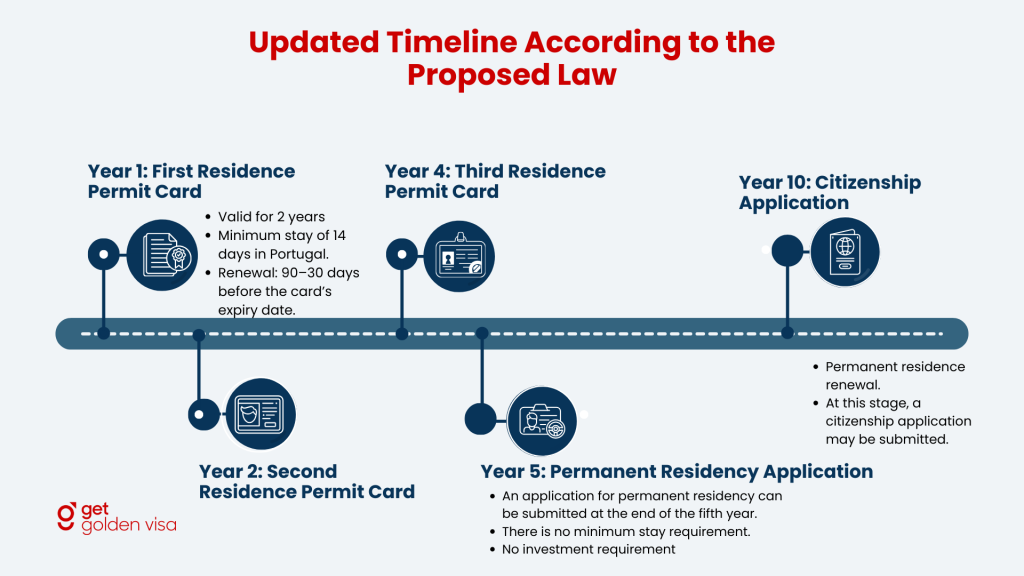
However, if the law is eventually approved, citizenship via the Golden Visa route will follow the new timeline, based on the citizenship application date and the issuance date of the first residence card.
What Happens if You Already Applied for Citizenship?
If you submit a complete citizenship application before any new law enters into force, your file is expected to proceed under the current five-year rule.
If the new law eventually enters into force, applications submitted after that date would fall under the new requirements.
In practical terms:
-
Completed applications already submitted continue under the existing five-year regime.
-
Future applications would follow the new seven- or ten-year rule only if the new law is upheld and comes into effect.
The absence of a formal transition clause has raised constitutional concerns.
If You Have Not Yet Applied for Citizenship
While the law is currently waiting for the President’s approval, if it eventually enters into force as approved:
- You will need to complete 10 years of legal residence (counting from the first residence card issuance date).
- You will need to meet the new language, civic, and conduct requirements.
- Proof of “real ties” and integration may likely become a stronger consideration in the process.
This will extend the timeline for citizenship for current and future Golden Visa holders who have not yet reached five years of residence.
Can You Still Get Permanent Residency After 5 Years?
Yes. This remains possible and is now more relevant than ever.
- After five years of legal residence, Golden Visa holders can apply for Permanent Residency (PR) in Portugal.
There are two PR routes to consider:
Regular PR (general regime): lower fees; typically requires proof of actual residence (e.g., a minimum stay over a multi-year period); each family member holds their own independent PR card.
Investment PR (for Golden Visa holders): it has higher fees; but it waives the minimum-stay obligation tied to PR; and each family member also receives an independent PR card.
Assuming you take advantage of the Investment PR:
- The PR card is valid for five years, renewable, and does not require full-time residence in Portugal.
- A2-level Portuguese language proficiency is required, but there are no new investment or physical stay obligations.
This means that after five years, investors can:
- Obtain PR and maintain their residency rights;
- Liquidate their qualifying investment if desired;
- Continue progressing toward citizenship under the new 10-year rule if they wish.
Important Strategy for Families
Continuing with the Golden Visa (ARI) renewals keeps family members dependent on the main applicant.
If children are approaching the program’s age limits, consider applying for Permanent Residency at year five so each family member holds an independent permit.
This reduces “age-out” risk and provides flexibility for studies, work, and travel.
- In recent months, AIMA accelerated the long-delayed scheduling of biometrics appointments for Golden Visa (ARI) applicants.
- Most primary applicants who had been waiting since 2022 – 2025 have now received invitations for appointments within 2026.
- At this stage, family members are not being scheduled an appointment. We are monitoring closely to see what approach AIMA will take on the dependents.
- These appointments are a positive sign that AIMA’s backlog is gradually clearing, though the overall processing pace still varies case-to-case.
Our Take
This reform represents a significant change in Portugal’s naturalization framework, aligning it more closely with European averages, but it also creates uncertainty for thousands of law-abiding residents and investors who made decisions based on the previous law.
At Get Golden Visa, we remain committed to:
- Providing clear, factual updates as the process evolves,
- Guiding our clients through their Permanent Residency and Citizenship strategies,
- Working closely with leading law firms in Portugal to ensure all applications remain compliant and well-timed.
This article reflects the situation as of May 3, 2026, based on:
- Official statements from the Portuguese Parliament,
- Legal summaries and expert analyses, and
- The text of the approved draft law.
We will update this page as soon as the President’s decision and the regulation details are published.
For guidance on how these changes may apply to your specific situation, timelines, or eligibility, you should consult your immigration lawyer directly. The interpretation and implementation of the new rules may vary depending on individual circumstances and future administrative practice. Our team remains available to provide general program and process guidance.
Contact Form