


In the US, a subtle but significant shift in migration is taking place. LGBTQ+ people are taking the lead in this movement as more Americans think about living abroad. The increasing uncertainty of access to fundamental rights is the driving force, not just the political environment.
For LGBTQ+ Americans, economic opportunity and lifestyle choices are no longer the only explanations for migration. It stems from more basic worries for an increasing number of people: safety, the continuation of rights, and the capacity to make uninterrupted plans for the future.
This migration wave is unique in that it is silent. Today’s decisions are rarely made public, in contrast to past movements influenced by retirement planning or job mobility. The terminology used by LGBTQ+ communities to discuss migration has changed significantly during the last two years. Discussions are more about possibilities than goals; they are less about uncertainties and more about procedures. This change can be seen in conversations about “Plan B,” dates discreetly noted on calendars, and legal documents created “just in case.” Many LGBTQ+ Americans now ask themselves, “Are we ready?” rather than, “Should we leave?”
The Point at Which Rights Turn Geographic
The US legal and political landscape has drastically changed in the last several years. In reality, access to rights depends more and more on geography, even when they are still recognized by the federal government. Safety now varies by place due to the erosion of federal protections and growing state-to-state differences. States currently differ greatly in terms of legal recognition, healthcare access, parental rights, and marriage equality.
The 2022 overturning of Roe v. Wade showed how easily a right that had been deemed settled for decades may vanish. Confidence in the durability of other accomplishments, such as marriage equality, was weakened by that ruling. Women’s and LGBTQ+ rights in the US have not developed in a straight line during the past 50 years; rather, they have alternated between advancement and retreat.
Legal experts now freely discuss situations in which same-sex marriage is still legal at the federal level but becomes practically impossible in some states. In these situations, couples might have to travel across state lines just to get married, which would result in major time, money, and logistical disparities. At this stage, migration becomes a planned security strategy rather than just an abstract possibility.
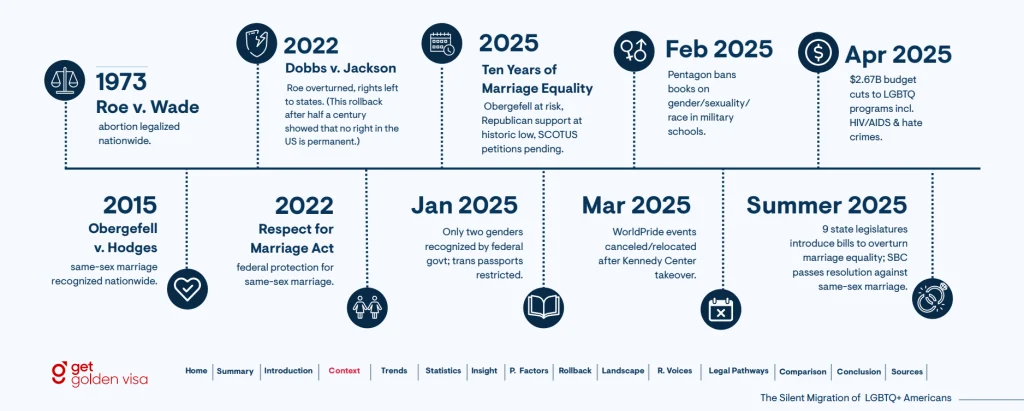
Context Timeline: 50 Years of Fragile Rights
Over the past half century, LGBTQ+ rights in the United States have followed a non-linear path, marked as much by reversals as by progress. What recent years have made clear is how quickly landmark rulings can lose their protective power.
What the Data Shows
At Get Golden Visa, trends often surface as behavioral signals before they appear in headlines. Since late 2024, there has been a marked increase in inquiries from US citizens researching residency options in Europe. A significant share of this interest comes from LGBTQ+ individuals and families, driven primarily by concerns around safety, long-term legal stability, and the ability to plan family life with confidence.
This is not an act of escape, but a cautious search for alternatives. Europe’s more inclusive legal frameworks are increasingly perceived not as a luxury, but as a safeguard, systems where rights are less vulnerable to abrupt political change.
No single statistic captures this movement, but multiple data points point in the same direction:
- As of 2024, approximately 5.5 million US citizens live abroad.
- In 1974, only 10% of Americans expressed interest in moving overseas; by 2024, that figure had risen to 34%.
- According to Get Golden Visa data, US-based web traffic increased ninefold following the 2024 presidential elections.
- In the first quarter of 2025, 15-20 % of Golden Visa applications from the US came from LGBTQ+ individuals.
The most frequently cited motivations include personal safety, family unity, legal predictability, and long-term stability.
These figures do not indicate mass migration, but rather a deliberate, early-signal movement built on planning and foresight.
An Example from the Field
Byrd A. (they/them), a relationship and intimacy specialist interviewed for Get Golden Visa’s most recent whitepaper research, provided an example from a same-sex couple in the Midwest.
The couple had been dating for years and had often talked about getting married, but they had put off getting married because of work and family obligations. They reevaluated as fresh threats to marriage equality emerged in the news cycle. They realized that waiting had become dangerous.
They traveled to a state that offered same-day marriage licenses with no waiting period because they were unwilling to deal with potential delays or abrupt policy changes in their home state. They finished a civil ceremony, obtained certified documents, and completed the inheritance and healthcare paperwork in less than a week.
When one partner needed unexpected surgery months later, the hospital recognized the other as the next of kin right away. It was a tale of caution rather than celebration.
What the Whitepaper Covers
Leaving to Belong: The Silent Migration of LGBTQ+ Americans brings together:
- The legal, political, economic, and psychological factors shaping migration decisions among LGBTQ+ Americans
- A comparative analysis of higher-risk and safer US states
- An examination of why inclusive European countries are viewed not as lifestyle upgrades, but as structural safeguards
- Expert insights and real-life case stories showing how individuals build “Plan B” pathways
- An overview of legal routes, residency options, and long-term planning strategies
A More Comprehensive Pattern
With the release of The Great American Exodus in 2022, Get Golden Visa started looking into Americans’ increasing interest in living overseas. Early studies concentrated on the factors that influence second residency and citizenship interest, including economic, political, and quality-of-life factors. Updates from 2024 indicated that the trend was picking up speed. The picture became more complex in 2025.
The movement to leave the US was no longer unified. The decision was being made by various groups for various reasons and at different times. Consequently, the study broadened into different groups, such as LGBTQ+ Americans, retirees, and foreign professionals.
‘Leaving to Belong: The Silent Migration of LGBTQ+ Americans’ focuses on the reasons why LGBTQ+ people frequently make earlier, more covert, and more calculated migration decisions than other groups. The study examines how mobility has evolved into a tool for defending rights rather than just pursuing opportunity by combining data analysis, legal context, expert insight, and lived experience.
Migration is more than just where people want to live in a time when rights feel more and more tentative. It has emerged as the most practical means for many LGBTQ+ Americans to safeguard something more fundamental: the capacity to fit in.
Contact Form